Some excerpts from the article :
KEY FINDINGS: WORD COUNT, PROFANITY, AND PRONOUNS
In terms of strategic cues, the researchers discovered the following:
Bald-faced liars tended to use many more words during the ultimatum game than did truth tellers, presumably in an attempt to win over suspicious receivers. Van Swol dubbed this "the Pinocchio effect." "Just like Pinocchio's nose, the number of words grew along with the lie," she says.
Allocators who engaged in deception by omission, on the other hand, used fewer words and shorter sentences than truth tellers.
Among the findings related to nonstrategic cues:
On average, liars used more swear words than did truth tellers—especially in cases where the recipients voiced suspicion about the true amount of the endowment. "We think this may be due to the fact that it takes a lot of cognitive energy to lie," Van Swol says. "Using so much of your brain to lie may make it hard to monitor yourself in other areas."
Liars used far more third-person pronouns than truth tellers or omitters. "This is a way of distancing themselves from and avoiding ownership of the lie," Van Swol explains.
Liars spoke in more complex sentences than either omitters or truth tellers.
The researchers also examined when and whether the receivers trusted the allocators—noting instances when receivers voiced doubts about the allocators' statements, and correlating the various linguistic cues with the accuracy of the receivers' suspicions. They also noted instances in which receivers showed no suspicion toward deceivers.
On average, receivers tended to trust the bald-faced liars far more than they trusted the allocators who tried to deceive by omission. In short, relative silence garnered more suspicion than flat-out falsehoods. "It turns out that omission may be a terrible deception strategy," Van Swol says. "In terms of succeeding at the deception, it was more effective to outright lie. It's a more Machiavellian strategy, but it's more successful."
POSSIBLE APPLICATIONS
In the latest phase of their research, the team is investigating the linguistic differences between lying in person and lying via email. Results regarding the latter may be increasingly useful as a larger portion of business is now being conducted via email, and such communications leave a transcript that can be analyzed carefully—and at leisure—by suspicious counterparts. "People detect lies better over the computer than they do face-to-face," Van Swol says.
That said, the researchers are quick to emphasize that linguistic cues are most definitely not a foolproof method of detecting lies, even among those who are trained to look out for them.
"This is early stage research," Malhotra says. "As with any such work, it would be a mistake to take the findings as gospel and apply them too strictly. Rather, the factors we find to be associated with lies and deception are perhaps most useful as warning signs that should simply prompt greater vigilance and further investigation regarding the veracity of the people with whom we are dealing."


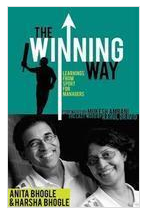 A famous sports commentator (who is himself an IIM-A grad) and his IIM-A grad wife join forces to write a book about how businesses can take valuable lessons from sports about winning, loosing, combating and rising above from failure. Interestingly this book also marks 300 training workshops for ‘The Winning Way’ that the Bhogle couple have led.
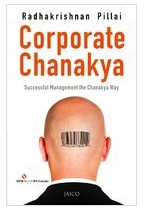 The last few years have regenerated an interest in ‘Arthashastra’ written by the great mathematician, administrator and statesman Chanakya. R Pillai has presented his version of the simplification of the sutras, mantras and trade secrets that Chanakya has explained in his original epic. More like a corporate guide, Pillai’s simplified version gives tips on management, leadership and training.
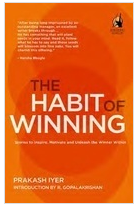 Here’s one more IIM-A grad who has jumped on the bandwagon of penning experiences based on his 25 year corporate career in which he sold everything from soaps to diapers. ‘The Habit of Winning’ is a mix about inspirational stories and real life incidents. From the Cola Wars to Michelle Obama’s brand management, these stories aim to inspire you to be a winner in everyday life.
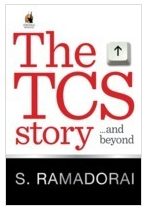 It’s amazing to read a book written by a man who has maneuvered his way through an organization for almost 40 years. From the days of Y2K when TCS expanded its client base to the IPO of TCS in 2004 to the potential merger with Tata Burroughs to the large scale recruitments drives that TCS is now undertaking, Ramadorai narrates a great journey that you ought to be a part of.
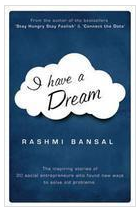 An MBA graduate from IIM-A herself, Ms. Bansal has already authored two bestselling books on entrepreneurship previously. While her first book talked about MBA graduates who jumped on the entrepreneurship bandwagon, her second book talks about non MBA graduates, her recently launched book ‘I Have a Dream’ talks about 20 idealists who become the change they want to see in the world.
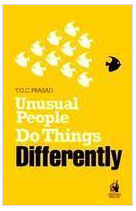 This book makes for an amazing read because it collects the success stories of 65 varied and interesting people – from famous people like Azim Premji and Mother Teresa to a common realtor, a CA, an attorney and a sports coach amongst many others. The common denominator that Prasad points out in all these people is their ability to think out of the box and accomplish extraordinary things.
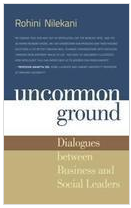 A philanthropist and a social activist by profession, Nilekani has penned this book based on interactions between business magnates and social leaders. Based on a TV show which she hosted in 2008, the book explores 8 major themes of polarization between business and voluntary social sectors. Capturing rare conversations between industry giants, Nilekani helps her readers realize that social and corporate developments inadvertently go hand in hand.
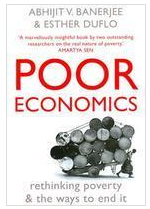 Co-written by MIT professors, Poor Economics answers questions of whether a billion hungry people really exist or not, why the poor who don’t have enough to eat end up buying a TV, how having more children directly relates to poverty and so on. If you want to learn more about the economics of poverty, pick up this book which is also the winner of the 2011 Financial Times and Goldman Sachs Business Book of the Year Award.
 Although IIPM and its founders have undergone a lot of controversy for their institute offering MBAs, this book remained popular in 2011. With none less than SRK launching this book, the main theme is about the hard selling strategies of modern day marketing. Formulating an acronym for THORN (Target It Right/ Hit Where It Hurts / Obsess With It / Reinvent It / Nail It / Sell It), the book pretty much maintains aggression in marketing as its central theme – sounds familiar to what IIPM is doing, isn’t it?
 Although this is not an Indian book, it has been a bestseller in India particularly because of the unfortunate death of Jobs, of course. Not much needs to be said about this book except that it is an absolutely stirring narrative of this creative genius. This book sold a little over 14,000 copies in its first week in India, compared with a